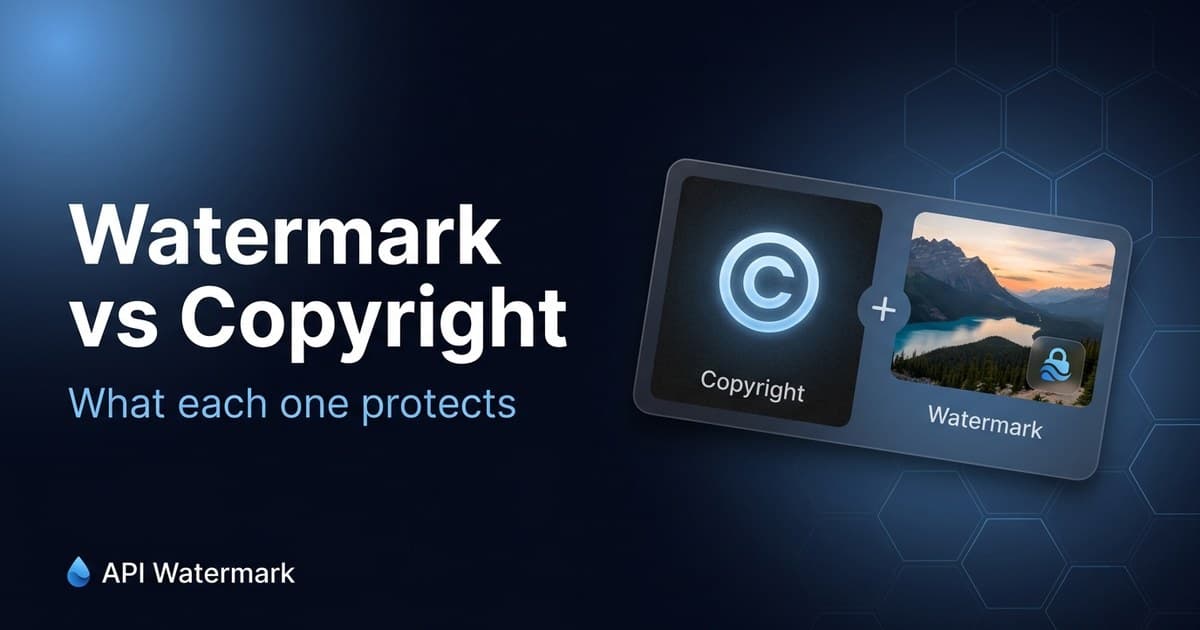
Copyright is a legal right: from the moment you press the shutter or export the artboard, you own the work, and nobody may reproduce it without permission. A watermark is a visible claim rendered into the pixels: it tells everyone who owns the image and deters casual reuse. One exists in law, the other in the file.
The practical difference shows up when something goes wrong. Copyright gives you the right to demand a takedown or damages — but only if you discover the infringement, can prove ownership, and are willing to act. A watermark works earlier in the chain: it prevents a large share of infringements from happening, marks the ones that do, and makes your ownership obvious without a lawyer.
1What copyright gives you (and when)
In nearly every jurisdiction, copyright is automatic on creation — no registration, notice, or © symbol required. You hold exclusive rights to reproduce, distribute, and display the work, typically for your lifetime plus decades. Anyone using your image without a license infringes, whether or not it was watermarked.
Registration is the upgrade, not the prerequisite. In the United States, registering with the Copyright Office before infringement (or within the statutory window) unlocks statutory damages and attorney's fees — which is what makes enforcement economically viable for individual creators. Unregistered, you can generally claim only actual damages, which for a web image is often too small to litigate.
Do
- Register your commercially important work where registration exists (e.g. US)
- Keep originals, RAWs, and project files — they're your ownership evidence
- Note upload dates and first-publication URLs for your key images
2What a watermark gives you (and when)
A watermark works before the law needs to get involved. It deters the casual taker who would otherwise right-click and move on, it keeps attribution attached as an image travels through reposts that strip captions and metadata, and it advertises the source to everyone who sees a stolen copy. None of that requires you to discover the theft or do anything at all — the pixels do the work.
It also strengthens the legal path it doesn't replace. A visible mark defeats the 'innocent infringement' defense (nobody credibly claims they didn't know a marked image was owned), and in US law, removing a watermark can itself violate the DMCA's protections for copyright management information — a separate claim on top of the infringement.
Don't
- Treat a watermark as legal protection — it's evidence and deterrence, not a right
- Rely on EXIF/IPTC copyright fields alone — platforms strip metadata on upload
- Assume caption credit on social media travels with the image — it doesn't
Put the visible half in place today
Batch-watermark your public images free — corner marks for posts, tiled marks for proofs. The legal half is yours; the pixels we can do right now.
3Where each one fails
Copyright fails on practicality: you must find the infringement, prove ownership, and spend time or money enforcing. Cross-border infringement, anonymous reposters, and sub-$1,000 damages make many valid claims not worth pursuing. Your rights are real; your enforcement bandwidth is the bottleneck.
Watermarks fail on determination: a skilled retoucher can remove most marks from a single image given time, and a corner mark falls to a simple crop. The mitigation is placement — tiled, low-opacity marks across detailed areas make removal cost minutes per image, which kills bulk theft — but a sufficiently motivated infringer of one specific image will always be able to try.
4Use both: the practical playbook
The working combination for most creators: watermark everything public (corner marks for attribution on portfolio and social, tiled marks for proofs and previews), register the commercially significant work where registration exists, and keep a light enforcement routine — reverse-image-search your best sellers quarterly, DMCA the infringements that matter commercially, ignore the rest.
The watermark handles volume: it prevents most casual theft across your whole catalog at near-zero cost. Copyright handles severity: when a business is monetizing your work, the registered right is what turns a polite request into a claim they must take seriously.